
 ខ្មែរ
Asia Pacific Farmers' Forum Platform, Farmers' Organizations for Asia, Policy Dialogue and Participation and Research/Study
Smallholder farmers (with small farm land size of under 2 hectares) make up roughly 68% of Cambodia’s 17+ million population and remain vital to food supply, yet face climate extremes, inflation, poor irrigation, monocropping, aging farmers, youth disinterest, and limited capital, certification (GI, GAP, PGS), and market access. CFAP Cambodia addresses these gaps through capacity building, agroecology, agroforestry, policy dialogue, and collective value chains. Achieving Cambodia’s Pentagonal Strategy, 2030 SDGs, UNDFF, and 2050 Vision requires stronger RGC - CSO collaboration, responsive laws, fair private-sector CSR, donor backing, and 5% - 10% GDP policy support to strengthen farmers' organizations, finance, year-round irrigation, and certification.
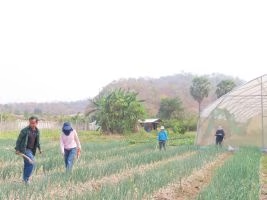
Cambodia remains a predominantly rural society, and the majority of rural Cambodians are smallholder family farmers and they live depend on much traditional agriculture to support their families without access to agricultural standards, processing, collective markets, or export markets. Smallholders have less than two hectares of farmland and represent about 68% of the total population of more than 17 million people. Based on the experiences of the Cambodian Farmer Federation Association of Agricultural Producers (CFAP) with farmers and rural poor farmers, we have realized that smallholders play an important role in producing food for their own consumption and for sale to clients to survive the family; however, they still face problems due to a fragile economy and can easily fall below the poverty line again, particularly in unforeseeable situations in the current global geopolitical context. Agriculture continues to play a significant role as farmers produce real food to feed people in response to increased food demand, while agroecology and agroforestry contribute significantly to human health, soil health, environmental health, safe food and sustainable food systems, as well as to building climate change resilience while Cambodia along with other countries in the Greater Mekong Subregion faces rising temperatures, rapid changes in weather conditions, heavy rain, floods, frequent storms, desertification, drought, and environmental pollution. This has inspired us, as a farmers’ association and part of civil society in Cambodia to put greater effort into working actively toward our vision, mission, objectives, and goals. CFAP Cambodia focuses mainly on capacity building, education, climate change, agriculture, agroecology, agroforestry, policy dialogue, policy participation, collective agribusiness strengthening, and market value chains in a constructive manner to ensure smallholders have a strong network from farm to markets, thus they can improve their livelihoods and the communities. In general, smallholders lack knowledge, skills in agricultural economics, economic literacy and capital to expand their production qualitatively, and technical skills, particularly knowledge of agricultural standards such as GI, GAP, PGS etc while sub national farmers’ organizations (SNFO) lack knowledge in business planning, entrepreneurship, innovation, and capital to collect produce collectively from farmers for processing, packaging, and timely market supply within a strong market structure from farm to major buyers and export markets. Smallholders also lack access to water for irrigation in both the rainy season and the dry season, as well as access to product traceability and certification. Rural youth are not interested in agriculture because they believe it is not profitable enough to cover current living expenses.
Many smallholders still lack access to quality seeds, and they grow crops on the same plot without rotating or changing crops, which consistently causes many problems for their crops such as low yields, widespread diseases, and contamination and leaves them vulnerable to rapid changes in weather conditions.
Smallholders need access to knowledge, skills, capital, innovation, product certification, markets, and year-round irrigation water from the government and development partners, which will contribute effectively to poverty reduction and food production toward sustainable agriculture, agroecology, and agroforestry transitions, so they can actively contribute to the 2030 Sustainable Development Goals, the UN Decade of Family Farming (UNDFF) 2019 - 2028, the Cambodian Agricultural Development Policy 2021 - 2030 (MAFF), and the Pentagonal Strategy of the Royal Government of Cambodia (RGC) on agriculture and farmer development toward modernizing rural communities and achieving better livelihoods under the 2050 Vision of the RGC in seventh mandate of the Cambodian National Assembly.
Certification of local agricultural and agroecological products, however, is costly for smallholders in the context of Cambodia and genuinely requires external support from the Royal Government of Cambodia (RGC) and the international community to make the smooth transition to close the level of LDC in 2030; nevertheless, certification for agricultural products and the strength of farmers’ organizations like CFAP Cambodia are key to promoting farmers’ produce to meet higher market demands including both local and export markets competitively, which the RGC, donors and development agencies should strongly consider for funding support to enable CFAP to achieve a quick win in rural development alongside the national political policy of economy by the end of 2029.
The growing impacts of climate change, global inflation, and uncertainty heavily affect smallholders because they depend on small-scale farming to support their families, alongside the rising number of aging farmers, the increasing number of youth who are uninterested in agriculture, and the fact that smallholders are always on the front line of every human-made and natural crisis; therefore, policy support including a package of roughly 5% to 10% of national GDP from the RGC to support farmers and national farmers’ organizations is key to unlocking barriers to agriculture, the rural economy, and development.
Furthermore, crop integration and diversification across agriculture, agroecology, and agroforestry models with better irrigation systems with water in a year-round can help smallholders improve their livelihoods in the future because they can harvest year-round, thereby also contributing to reducing carbon emissions to help limit global warming to 1.5°C by 2030. Small-scale farmers need to diversify their incomes from agriculture by restructuring their existing systems to engage with markets and other actors, such as the private sector, processors, the public sector, producer associations, NGOs, researchers, and academia. Moreover, farmers need access to finance with clear policy support from the Royal Government of Cambodia (RGC), whereas Cambodia still lacks a clear financial support policy for farmers and national farmers’ associations, the Law on Associations and Non-Governmental Organizations remains unresponsive to the social development needs of rural communities in terms of fairness, accountability, transparency, and equality between the RGC and CSOs in Cambodia, and corporate social responsibility (CSR) is still not applied fairly by the private sector and/or large companies. We feel that there is still a wide gap between the RGC and CSOs in Cambodia, especially farmers’ organizations (FOs) as part of civil society and this gap needs to be reduced and bridged toward better collaboration and partnership in development in the future.